HomeServicesAudit and Risk Advisory

Internal Audit and Enterprise Risk Advisory for Financial Institutions

A board asks a straightforward question: what are our largest risks, who is telling us they are covered, and where are we knowingly exposed? Answering it should not require three functions to reconcile three spreadsheets first. Helios builds the risk and audit capabilities that let a financial institution answer in one voice, with data behind the answer and a reporting line the committee trusts.

Request a consultation

What Is Audit and Risk Advisory?

Audit and risk advisory is the work of designing, assessing, and executing the lines of defense: enterprise risk management, internal audit, business controls, governance, and the reporting that carries their conclusions to the board. Helios performs that work for asset managers and financial services firms, either as an advisor to your existing functions or as the practitioner who builds and runs them with your team.

The more useful question is what those functions return. Protection is the floor. Firms that get this right execute strategy faster, because leadership can see which growth priorities carry which exposures.

Our practice is led by the former Chief Auditor of Allspring Global Investments, who reported to the Board Audit and Risk Committees and built that firm's internal audit function from the ground up after its separation from Wells Fargo Asset Management. Earlier, as Head of Internal Audit at MFS Investment Management, she rebuilt that function around the firm's priority initiatives. You engage that experience directly. There is no junior bench behind the introduction and no methodology deck standing in for judgment.

Is your risk function adding value or completing a paper exercise?

Do you know where your exposures sit, what remains unknown, and how to move from reactive to proactive to predictive? Our practice lead's risk experience runs back to the implementation of Basel II, when operational risk first entered the calculation of capital adequacy. Most firms work through the standard list of maturity improvements in strict sequence and lose years doing it. We know which steps run in parallel and which a firm can skip.

AI is the question your executives are being asked this year.

Using it for more than employee efficiency depends on connected data. Elements across governance, risk, compliance, and audit have to relate to one another before a model can say anything defensible about exposure. Building those connections is more achievable than most firms assume.

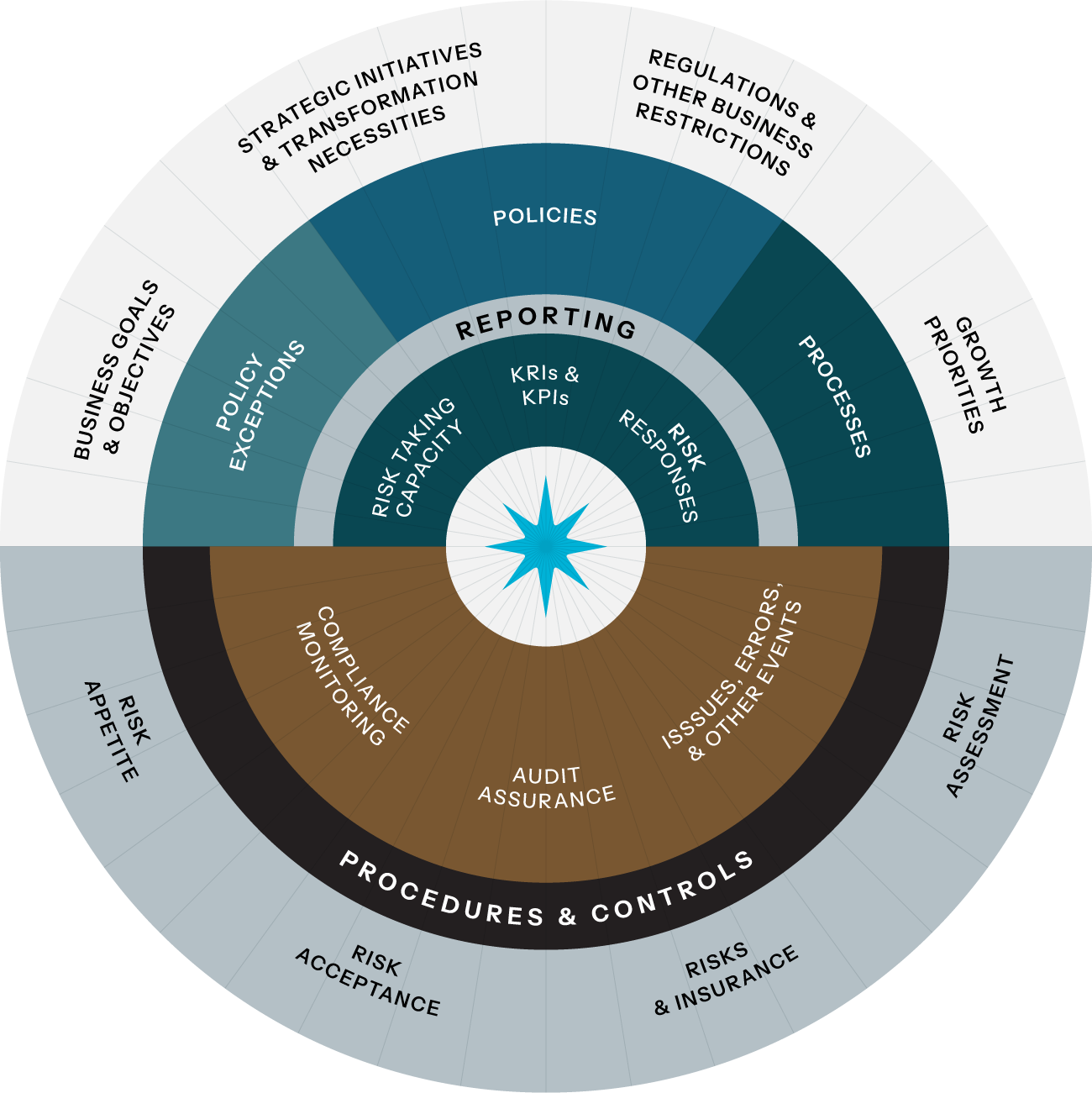
Audit and risk advisory wheel connecting strategy, governance, reporting, controls, and assurance

The GRCA Data Ecosystem

Risk, compliance, audit, and control data usually live in systems and reports selected separately, by different functions, in different years. Each is defensible on its own terms. Together they produce a board pack where the same exposure appears three times under three names, and a management team that spends the meeting reconciling numbers instead of deciding anything.

Helios connects that data into one decision-making framework and moves review and challenge out of board preparation and into the forums where it belongs. The work scales to where you are, and it can begin with a single data point.

Four Levels of Engagement

Single data element solution

Discrete work: issue remediation, risk taxonomy, control inventory management, assurance mapping, testing automation, control redesign, or any other element in the ecosystem. We solve the specific problem, show how it connects to everything around it, and leave the data in a condition AI can use.

Discipline-specific strategy

A modern, practical data strategy inside one function, whether Risk Management, Compliance, Internal Audit, or Business Controls. Part of the value is showing stakeholders what the function contributes to strategy, rather than only what it protects.

Cross-functional integration

Connecting data across disciplines to eliminate fragmented views of risk. This is where a firm stops reacting and starts anticipating, because stakeholders finally see one version of the exposure.

Enterprise-wide GRCA data strategy

A holistic strategy across the full ecosystem, so executives and the board decide with clarity, speed, and confidence. This is the point at which a program becomes predictive.

Enterprise Risk Management and Assessment

Most risk frameworks were built to satisfy an obligation, then inherited by people who had no part in designing them. They produce documents on schedule and tell executives little they did not already know. We rebuild the work around the decisions your leadership actually makes, so governance forums hold real discussions about risk-taking.

Risk appetite and risk-taking capacity

Appetite is the risk a firm is willing to accept. Capacity is what it can absorb given capital, resources, and operational limits. Firms routinely set the first in general terms without measuring the second, then find the gap during a market event, a regulatory action, or a vendor failure.

We define both in terms your board can approve and your business heads can apply. Risk acceptance decisions get documented, and the exceptions process goes in writing so approvals and expirations stay visible rather than remembered.

None of this requires a formal methodology across every control. It requires knowing what control costs, where capacity sits, and how to adjust coverage as conditions change. Without that, the risk function drifts out of step with strategy.

Risk assessment and forecasting

Standard methodology evaluates likelihood and impact. We add velocity and leading indicators drawn from data already inside your organization: error and near-miss patterns, service level performance, control failure trends, attrition in critical functions, and testing results across compliance, risk, and audit. External and geopolitical developments that touch your strategies belong in the same view.

The output balances quantitative measures against qualitative judgment. It is built to direct where you invest control spending next year, not to describe last year.

Integrated risk reporting and key indicators

Key risk indicators fail when nobody can trace them to a control. Reports arrive monthly, look complete, and give the control owner nothing to act on. They rarely reach the audit plan, so a moving number never prompts anyone to revisit coverage.

We design indicator sets that tie back to control performance and service levels. A change in a number then tells you which process moved and who owns it. Predictive indicators are the objective, because they allow a change to an audit, compliance, or risk plan while the change still matters.

There is a recognition problem worth naming. When an error is prevented, the save is invisible and the function that prevented it gets no credit. Near-miss evaluation through the GRCA data ecosystem gives executives a way to quantify what protection returns.

Control inventory and redesign

A control inventory nobody trusts is worse than none, because it produces duplicative testing and blind spots at once. We take on taxonomy, inventory rationalization, control redesign, and testing automation, mapping controls to the risks and obligations they address.

That work follows a step most firms skip. Business objectives and growth priorities have to be understood first, from the people who own revenue. Risk has no meaning until the firm's goals and its regulatory requirements are both on the table.

Controls sit at the lowest level of detail in the GRCA data ecosystem. An inventory built without those connections becomes a silo boards struggle to relate to and rarely fund. Built correctly once, it holds its value across every strategic goal that follows.

Who this fits

Firms standing up an enterprise risk or internal audit function. Firms whose risk committee materials have grown longer without growing clearer. Firms where risk, compliance, audit, and business controls each hold a separate view of the same exposure.

Internal Audit Function Design, Co-Sourcing, and Assurance Mapping

An internal audit function owes the board independent assurance and advice. That is difficult when the function is new, thinly staffed, generalist in a specialist industry, or reporting on processes it helped design. Helios has been inside that problem, and builds functions that hold up to committee scrutiny and to external quality assessment under the IIA Global Internal Audit Standards.

Building or rebuilding the function

Audit charter, reporting lines, risk-based audit universe and planning, methodology, workpaper standards, issue and follow-up protocols, and committee reporting cadence, aligned to the IIA Global Internal Audit Standards.

We align the underlying data across the GRCA data ecosystem at the same time, so integrated assurance is possible and governing bodies see one view of risk rather than several. This is the work of standing up a function a board audit committee will rely on. Our practice lead has done it from a blank page at Allspring and helped reconstruct the function at MFS Investment Management during a period of heavy regulatory scrutiny.

Co-sourced and specialist execution

Where your function exists but lacks capacity or depth, we execute audits and advisory reviews as part of your team rather than a parallel one.

Investment management carries specialist scope that generalist audit shops handle poorly: trading and best execution, valuation, affiliated transactions, sub-adviser and service provider oversight, fund accounting and transfer agent activity, models and portfolio analytics, and the AI-enabled tooling now embedded across all of it. Our AI work extends to the controls and assurance around it, not only the policy language.

Assurance mapping

Four functions test the same process, none of them knows it, and the risk nobody covers is the one that reaches the board unannounced.

Assurance mapping produces a single view of who tests what, at what depth, and how often. It reduces duplicative testing, exposes the genuine gaps, and gives your committee a defensible answer to the coverage question. The work commonly returns testing hours to the business.

Issues, remediation, and resiliency

Tracking that ties findings to controls, and controls to the risks and initiatives they threaten, shows a firm where it needs to invest. Root cause analysis that separates a one-time error from a control weakness connects remediation spending to a result you can point to.

We support firms working through the remediation of a regulatory matter, including validation that the remediation held. Operational resiliency work covers critical process mapping, dependencies, and recovery expectations.

Who this fits

Firms with a board audit or risk committee. Firms whose internal audit or risk functions are new or one person deep. Firms preparing for an external quality assessment. Firms carrying a remediation commitment they intend to close properly.

We Have Worked Every Line of Control

The IIA published "The Three Lines of Defense in Effective Risk Management and Control" in January 2013 and reissued it as "The IIA's Three Lines Model" in July 2020. Outside banking, adoption was never required. The papers described sound practice: business controls in the first line, risk and compliance in the second, internal audit in the third.

Advisors who have only occupied one of those seats recommend solutions that work from that seat and create friction in the other two. Our practice lead has built and led functions across all three: compliance quality assurance, operational risk leadership, strategy, analytics, governance, business controls, and internal audit transformation more than once. That range is why our recommendations account for what the first line can execute and what the second and third lines will be able to test.

What Changes for the Board

One view of risk that stands up to challenge. Disparate views reconciled into a single picture the committee can act on.

Appetite you can manage. Exposure measured against stated appetite and actual capacity, with acceptance decisions documented.

Coverage you can prove. An assurance map that answers who tests what, and where nobody is looking.

Resources aimed correctly. Duplicative testing removed, and testing hours redirected to genuine risk.

Strategy with evidence behind it. Movement on the firm's priorities, with a record of what risk and audit contributed.

Common Questions About
Audit and Risk Advisory

An external audit is performed by an independent public accounting firm and results in an opinion on financial statements or a control environment. Helios does not perform that work and does not issue those opinions. Our work sits on the internal side, designing and executing the audit and risk activities that report to your management and your board. It is scoped to your firm rather than run from a checklist.
